

What Does the Sum Mean in Math? Definition, Symbol, and Examples
Quick answer: In math, the sum is the result of adding two or more numbers. For example, in 8 + 3 = 11, the numbers 8 and 3 are the addends, and 11 is the sum. For long lists, the Greek letter sigma (∑) is used as shorthand for “add all of these up.”
You see the word “sum” in school worksheets, shopping bills, spreadsheets, and statistics. It looks simple, but it leads to bigger ideas, including sequences, averages, and sigma notation. This guide explains what the sum means in math, how to find it, which formulas save time, and where students usually go wrong.
What Does the Sum Mean in Math?
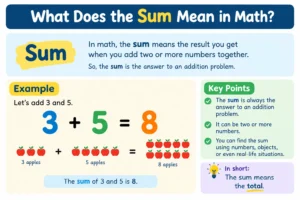
The sum is the total you get after adding numbers together. The numbers being added are called addends (or terms). The answer is the sum.
addend + addend = sum, for example 5 + 7 = 12
Here 5 and 7 are the addends, and 12 is the sum. Other words with the same meaning are total, aggregate, and tally. The process is called addition, or summation when many terms are involved.
Sum vs Difference, Product and Quotient
Each basic operation has its own name for the answer. Mixing these up is a very common mistake.
| Operation | Name of the answer | Example |
| Addition (+) | Sum | 9 + 4 = 13 |
| Subtraction (−) | Difference | 9 − 4 = 5 |
| Multiplication (×) | Product | 9 × 4 = 36 |
| Division (÷) | Quotient | 8 ÷ 4 = 2 |
What Is the Symbol for Sum?
- Plus sign (+): adds numbers one by one, like 12 + 8.
- Sigma (∑): the capital Greek letter used in sigma notation to show the sum of many terms compactly.
How to Read Sigma Notation
∑ (from i = 1 to 5) of 2i = 2 + 4 + 6 + 8 + 10 = 30
| Part | Meaning |
| ∑ | “Add up all the terms” |
| i = 1 (bottom) | Start counting at 1 |
| 5 (top) | Stop at 5 |
| 2i | The rule used for each term |
Replace i with 1, 2, 3, 4, and 5, then add the results. That is all sigma notation does.
How to Find the Sum of Numbers (Step by Step)
For small numbers, you can add in your head. For bigger numbers, use column addition.
Example: find the sum of 89 and 22.
Write the numbers in columns, lining up the ones and tens.
Add the ones: 9 + 2 = 11. Write 1 and carry 1.
Add the tens: 8 + 2 + 1 (carried) = 11.
The sum is 111.
On a number line, start at 89, jump 20 to reach 109, then jump 2 more to reach 111. Both methods give the same answer.
Important Sum Formulas
When you need the sum of a long, regular pattern, a formula is faster than adding every term.
| What you are adding | Formula | Example |
| First n natural numbers | n(n + 1) / 2 | 1 to 10 = 10 × 11 / 2 = 55 |
| First n odd numbers | n² | First 5 odd numbers = 25 |
| First n even numbers | n(n + 1) | First 5 even numbers = 30 |
| Squares of the first n numbers | n(n + 1)(2n + 1) / 6 | 1² to 5² = 55 |
| Cubes of the first n numbers | [n(n + 1) / 2]² | 1³ to 4³ = 100 |
| Arithmetic series | n(a₁ + aₙ) / 2 | 3, 6, 9 … 30 = 10 × 33 / 2 = 165 |
Chart: The Sum of the First n Odd Numbers Equals n²
Adding 1, then 3, then 5, and so on always lands on a perfect square.
| n | Odd numbers added | Sum | Growth |
| 1 | 1 | 1 | ▏ |
| 2 | 1 + 3 | 4 | ▍ |
| 3 | 1 + 3 + 5 | 9 | ▉ |
| 4 | 1 + 3 + 5 + 7 | 16 | ██ |
| 5 | … + 9 | 25 | ███ |
| 6 | … + 11 | 36 | ████ |
| 7 | … + 13 | 49 | █████ |
| 8 | … + 15 | 64 | ██████ |
| 9 | … + 17 | 81 | ████████ |
| 10 | … + 19 | 100 | ██████████ |
(Agar website par asli graph chahiye to upar wali file ke andar SVG bar chart ready hai.)
How to Find the Sum of 1 to 100 Fast
A popular story says the mathematician Carl Friedrich Gauss solved this as a schoolboy. Pair the numbers from both ends: 1 + 100, 2 + 99, 3 + 9,8 and so on. Every pair makes 101, and there are 50 pairs.
50 × 101 = 5,050
This is exactly what the formula n(n + 1) / 2 does.
Worked Examples
Example 1: Word problem. A bakery sold 112 loaves on Monday and 184 on Tuesday. How many were sold in all?
112 + 184 = 296 loaves.
Example 2: Decimals. Ben finds $2.75 in his room and $4.09 in his car. Total found?
2.75 + 4.09 = $6.84.
Example 3: Natural numbers. Find the sum of the first 30 natural numbers.
30 × 31 / 2 = 930 / 2 = 465.
Example 4: Arithmetic series. Find the sum of 2, 5, 8, 11 … up to the 20th term.
Last term: 2 + (20 − 1) × 3 = 59. Sum = 20 × (2 + 59) / 2 = 610.
Where the Sum Is Used in Real Life
- Shopping and budgeting: the sum of all item prices is your bill.
- Statistics: the mean (average) equals the sum of values divided by how many there are. Add 4, 8, and 12 to get 24, then divide by 3 to get a mean of 8.
- Estimating and measurement: project costs, material quantities,s and areas are built by adding smaller parts into a total.
- Spreadsheets and finance: the SUM function in Excel exists for exactly this reason.
Common Mistakes to Avoid
- Calling the answer of a multiplication “the sum.” That is the product.
- Forgetting to carry: in column addition.
- Misaligned decimals: Always line up the decimal points before adding.
- Wrong n in a formula: n is the number of terms, not always the last number.
Tip: Check your answer by adding in reverse order. The sum stays the same because addition is commutative: 8 + 3 = 3 + 8.
Practice Questions
What is the sum of 140 and 93?
Find the sum of the first 15 natural numbers.
What is the sum of the first 10 even numbers?
Evaluate ∑ (i = 1 to 4) i².
Answers: 1) 233 2) 120 3) 110 4) 1 + 4 + 9 + 16 = 30
Frequently Asked Questions
Does sum mean add?
Yes. The sum is the result of adding two or more numbers. It never means subtract, multiply, or divide.
What is the symbol for sum?
The plus sign (+) shows addition, and the Greek letter sigma (∑) stands for the sum of a list or sequence of terms.
What is the sum of numbers from 1 to 100?
The sum is 5,050, using n(n + 1) / 2 with n = 100.
What is another word for sum in math?
Total, aggregate, and tally. The process is called addition or summation.
Is the sum used for multiplication?
No. The answer to multiplication is the product. Multiplication can be seen as repeated addition, but its result is not called the sum.
Key Takeaways
- The sum is the answer you get when you add numbers.
- The numbers you add are called addends.
- The symbols are + for simple addition and ∑ for long lists.
- Formulas such as n(n + 1) / 2 turn long additions into one quick step.
Conclusion
The sum in math is simply the total you get when you add two or more numbers together. In other words, the numbers you add are called addends, and the answer is the sum. For example, you can show it with the plus sign (+) for everyday addition, or with the sigma symbol (∑) when you need to add a long list of terms. Once you understand this basic idea, bigger topics become easier, including column addition, averages in statistics, arithmetic series, and formulas like n(n + 1) / 2. In addition, remember the difference between the sum (addition), difference (subtraction), product (multiplication), and quotient (division). Finally, always double-check your work by adding in reverse order.
Therefore, practice the examples and questions above a few times, and finding the sum of any set of numbers will become quick and natural. If you have a question about sums or any other math concept, leave it in the comments, and we will be happy to help.
